
Summary: Confused about freight shipping costs? Discover the key components, hidden fees, additional charges, and factors influencing your freight quote.

Looking to ship goods internationally or domestically? Understanding the key components of freight shipping costs makes budgeting and decision-making simpler.
This guide breaks down the factors that shape your freight shipping quote, helping you manage your logistics budget and avoid unexpected fees.
What are freight shipping costs?
Freight shipping costs encompass all charges associated with transporting goods. This includes transportation, handling, fuel, cargo specifications, customs duties, and surcharges. Knowing what drives shipping rates helps optimise your shipping strategy and enables you to avoid hidden charges.
Key components of freight shipping costs
Here are the five main expense categories that directly affect your freight quote:
1. Type of freight (spot or contract)
-
- Contract shipping offers predictable costs with long-term agreements, ideal for consistent freight needs and guarding against market volatility.
- Spot shipping can offer flexibility. Weigh your options and choose the option that aligns with your cargo volume and shipping needs.Choose based on the frequency and consistency of your shipments.
2. Mode(s) of transportation (air, sea, or land)
-
- Air freight: Fast but costly, ideal for time-sensitive shipments.
-
- Sea freight: Relatively economical but slower, suitable for large-volume shipments.
-
- Land freight: Flexible and cost-effective for domestic or regional shipments.
Most shipments involve multiple modes. As explained below, the key is to choose the freight service that incorporates the best mode(s) of transport to meet your shipment’s requirements.
3.Cargo weight and dimensions
Shipping rates depend on the standard weight or volumetric weight (whichever is greater). Larger or heavier shipments require more space and handling, raising the cost.
4. Shipping route and complexity
Longer and/or more complex shipping routes (with multiple stops or remote locations) increase costs due to additional resources and logistics planning. Choose straightforward routes when possible to reduce costs.
5. Tariffs, duties, and taxes
International shipments incur customs duties and taxes, which depend on cargo classification and regulations. Proper documentation and accurate HS codes help minimise unexpected charges.
Types of freight shipping services
Each shipping service type has its own set of advantages and is suited to different needs. Here’s a breakdown of the main options:
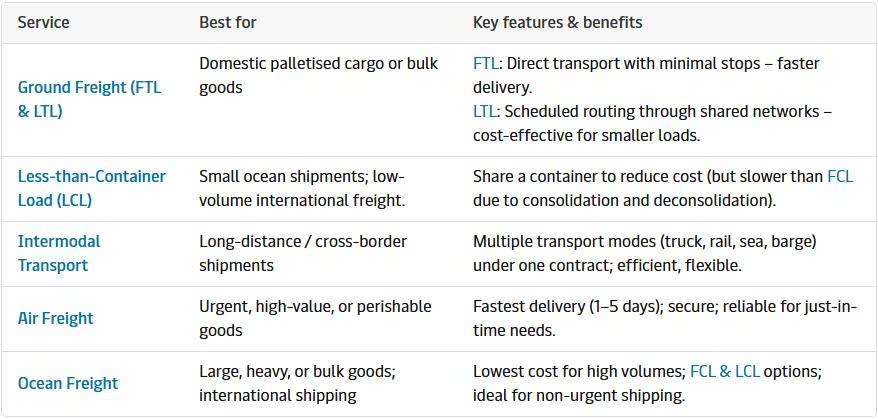
Additional fees and charges
Beyond the basic freight shipping costs, there are additional charges that can impact your final quote:
Fuel surcharges
Fluctuating fuel prices often result in variable surcharges that can significantly affect your shipping cost. Choose carriers with fuel-efficient options to reduce this impact.
Terminal handling charges (THC)
These fees are applied at ports or terminals for loading, unloading, and handling cargo. They vary depending on the terminal and can be minimized by negotiating efficient handling times.
Demurrage and detention (D&D) charges
Delays can be costly. Demurrage charges kick in if your container overstays inside the port, while detention fees arise for container overstays outside the port. To avoid expensive D&D charges, plan transit schedules realistically and coordinate closely with your logistics provider.
Special handling fees
Hazardous, oversized, or temperature-sensitive cargo often requires specialized handling, incurring extra fees. Ensure your cargo is accurately declared and packaged to manage these additional costs.
Other shipping costs to consider
Here are a few indirect or less obvious costs associated with freight shipping:
Packing and palletisation
Inefficient packing and oversized pallets waste space, increasing shipping costs. Use space-efficient packaging and standard pallet sizes to manage costs.
Cargo insurance
Freight insurance protects goods from damage or loss. While it adds to the cost, it significantly reduces risk, especially for high-value or fragile cargo. Carefully evaluate the necessity based on your cargo’s value and risk factors.
Peak season surcharges
Shipping during peak seasons, like Black Friday or Chinese New Year, often leads to higher costs due to increased demand. Schedule your shipments outside of peak periods if possible to minimise extra costs.